
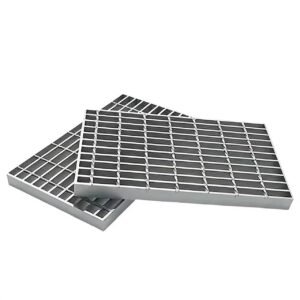
In industrial plants, municipal construction, transportation hubs and other scenarios, steel grating has become an indispensable structural component thanks to its unique grid structure and excellent performance. As an open steel component assembled by orthogonally combining bearing flat bars and cross bars, fixed by welding or press-locking, steel grating offers both practicality and cost-effectiveness, and is widely adaptable to various complex engineering requirements. This article comprehensively analyzes the value of steel grating from its core features, product types, application scenarios and selection guidelines, providing a reference for engineering procurement and application.
Core Features: Performance-Oriented and Practical Design Advantages
- Balanced High Strength and Light Weight
Made of high-quality low-carbon steel, stainless steel or aluminum alloy, steel grating features firm structure and high load capacity through precision welding or press-locking of bearing flat bars and cross bars. It easily accommodates scenarios with heavy-duty vehicles, heavy equipment and high-frequency pedestrian traffic. Meanwhile, its open structure significantly reduces self-weight, making it more convenient for transportation and installation compared with traditional solid plates, lowering construction and labor costs.
- Multi-Functional Practical Design
– Ventilation and Heat Dissipation: Grid gaps enable efficient ventilation, lighting and heat dissipation, suitable for power stations, boiler rooms, chemical workshops and other environments requiring ventilation and cooling, reducing equipment operating load.
– Safety and Anti-Slip: Bearing flat bars can be smooth or serrated. Serrated flat bars improve friction coefficient in wet and oily environments, effectively preventing slips and ensuring operational safety.
– Corrosion Resistance and Durability: Surface treatments include hot-dip galvanizing, electro-galvanizing, painting or stainless steel material. Hot-dip galvanizing forms a dense protective layer, resisting acid-alkali corrosion and oxidation, extending service life — especially ideal for harsh environments such as coastal and chemical industries.
– Easy Maintenance and Self-Cleaning: The grid structure does not accumulate rain, snow or dirt. Daily cleaning only requires simple rinsing, reducing maintenance costs and time.
Main Product Types: Versatile Options for Diverse Scenarios
- Welded Steel Grating
Bearing flat bars and cross bars are fixed by high-pressure resistance welding, featuring firm connection, stable structure and smooth surface. It is the most widely used type, suitable for conventional scenarios such as industrial platforms, stair treads and drain covers.
- Press-Locked Steel Grating
Flat bars are punched and mechanically locked with cross bars without welding. It features high lateral stiffness and greater load capacity, ideal for high-load scenarios such as heavy-duty platforms, ports, docks and large warehouses.
- Swaged/Interlocked Steel Grating
Assembled by intercrossing flat bars, it combines aesthetic appeal and load-bearing performance with uniform gaps and compact structure. Suitable for scenarios with high appearance requirements, such as municipal landscape walkways, shopping mall ceilings and high-end architectural decoration.
- Special Material Steel Grating
– Stainless Steel Grating: Outstanding corrosion resistance, suitable for food processing, pharmaceuticals, coastal buildings and other scenarios with strict hygiene and anti-corrosion requirements.
– Aluminum Alloy Grating: Lightweight, corrosion-resistant and aesthetic, ideal for lightweight scenarios such as aviation, shipbuilding and light architectural decoration.
Key Selection Guidelines: Precise Matching to Engineering Requirements
- Clarify Application Scenario and Load Capacity
Determine load class based on usage:
– Pedestrian Walkways: 25mm-height flat bars for normal pedestrian traffic.
– Light Vehicles / Carts: 32mm-height flat bars, balancing load capacity and cost efficiency.
– Heavy Equipment / Forklifts: 40mm-height flat bars or above to ensure structural stability.
- Choose Appropriate Material and Surface Treatment
– General Industrial / Municipal Scenarios: Hot-dip galvanized low-carbon steel is preferred for high cost-performance and durable corrosion resistance.
– High-Corrosion / Hygiene-Critical Scenarios: Stainless steel for chemical, food and pharmaceutical industries.
– Lightweight Scenarios: Aluminum alloy to reduce structural load.
- Confirm Specification Parameters
– Bearing Flat Bars: Common sizes include 25×3, 32×3, 40×5, selected based on load calculation.
– Cross Bar Spacing: Standard 50mm and 100mm, customizable on request.
– Dimension Customization: Length and width designed according to on-site space; non-standard customization available.
Conclusion and Call to Action
With core advantages of high strength, light weight, easy maintenance and high adaptability, steel grating is a reliable choice for industrial and engineering fields. For both standard projects and special scenarios, accurate selection and high-quality products are critical to ensuring engineering quality and service life.